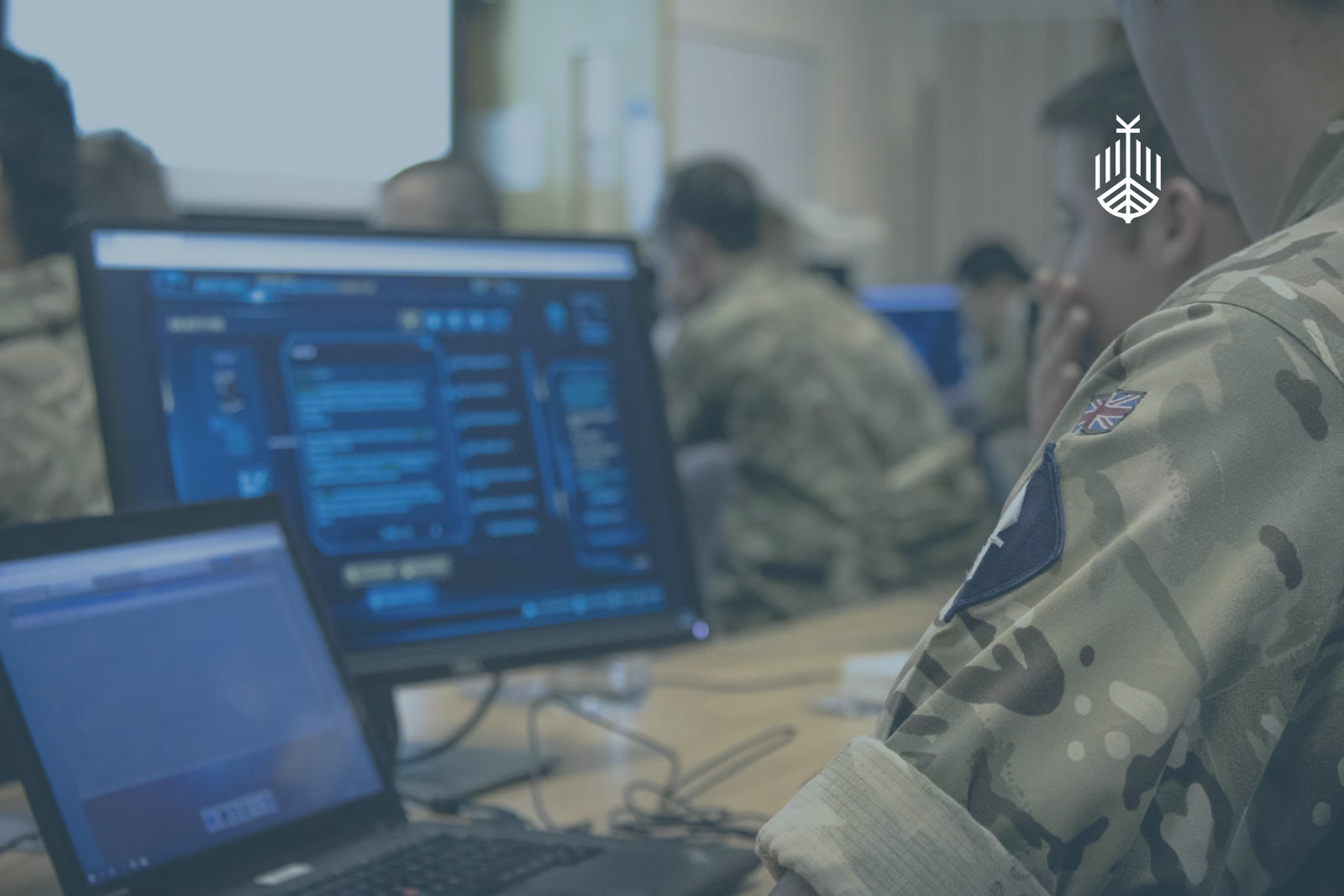
As geopolitics fractures global markets, military decision-making frameworks are becoming strategically valuable.
The rules-based order that underpinned four decades of globalisation appears increasingly fragile. Supply chains once optimised purely for cost efficiency are being redesigned with resilience as a primary constraint. Capital allocation, according to UNCTAD data showing declining foreign direct investment flows in 2024, now operates within a web of sanctions regimes, industrial policy requirements, and non-commercial considerations. Technologies such as AI, advanced semiconductors, and quantum computing capabilities that previously functioned as straightforward competitive tools face growing treatment as strategic assets subject to export controls and jurisdictional restrictions.
The business environment executives now navigate bears less resemblance to the predictable rhythms of market competition than to what Thomas Hobbes termed bellum omnia contra omnes, a condition where disruption, coercion and sudden constraint function as baseline operating assumptions rather than exceptional risks. The sharp decline in Suez Canal trade volumes during early 2024, triggered by Red Sea security disruptions, demonstrated how rapidly the denial of a single corridor can cascade through lead times, inventory positions, and cash conversion cycles across entire industries. Such incidents suggest a structural shift rather than a series of isolated shocks.
This environment appears to reward a particular form of decision architecture: one built for operating under uncertainty, enabling decentralised execution, and supporting rapid adaptation when conditions shift. These characteristics define how modern military organisations train their leaders and structure their operations. The convergence suggests that military talent may represent a strategic capability acquisition rather than a symbolic hiring gesture.
How established planning frameworks encounter friction
Business leaders across sectors report a common pattern: planning frameworks calibrated for stable regulatory environments and relatively long decision cycles struggle when conditions change faster than approval processes can escalate responses. Corporate hierarchies designed for top-down control encounter systematic difficulties when operating environments require delegation to those closest to emerging problems. Risk functions built to quantify tail events find their models less useful when the tail represents the central operating condition.
The practical manifestations follow recognisable patterns. A European manufacturer discovers its semiconductor supplier subject to new US export controls, triggering a six-month product architecture redesign. Logistics companies watch optimised Red Sea routing become non-viable within weeks. Technology platforms learn their AI capabilities now carry dual-use classifications, converting product development questions into matters requiring coordination across legal, compliance, and government relations functions. These examples, drawn from recent corporate disclosures and earnings calls (the Federal Reserve tracks such geopolitical references in earnings-call language), indicate pressure points where existing decision frameworks encounter systematic resistance.
A less visible but perhaps more consequential challenge emerges from what might be termed the erosion of shared commercial assumptions. The working presumption that market actors operate under broadly comparable rules, toward mutually intelligible objectives, within a common institutional framework no longer appears reliable. What constitutes rational behaviour in one jurisdiction may generate regulatory penalty in another. Security considerations, sovereignty constraints, and industrial capacity goals now carry variable weight across different markets. This fragmentation multiplies the signals that require interpretation while simultaneously rendering their meanings more ambiguous. A supply chain optimisation that appears economically sound in one quarter may create unacceptable political exposure by the next.
Why military cognitive frameworks may transfer value
Military organisations worldwide structure their officer development around a consistent set of capabilities: making consequential decisions despite incomplete information, assessing risk under compressed timelines, and prioritising mission achievement over procedural compliance. They routinely operate across coalition structures where partner organisations do not share doctrine, operate under different political constraints, and pursue divergent national objectives. These conditions approximate the fragmented commercial environment described above.
Contemporary military doctrine increasingly emphasises what is termed mission command: establishing clear intent at senior levels while delegating execution authority to those positioned closest to emerging problems. In organisational terms, this represents a high-velocity operating model combining aligned strategic outcomes with flexible tactical methods and structured feedback mechanisms. The approach appears predicated on institutional values that privilege decisive action, accept calculated risk, and maintain operational tempo despite setbacks. Where business school frameworks often emphasise gathering additional data to reduce uncertainty before committing to action, military training conditions leaders to act, observe results, adjust approaches, and maintain forward momentum.
The cognitive patterns developed through military service may carry particular value in environments where decision cycles compress, unforeseen constraints emerge with high frequency, and the capacity to pivot rapidly influences competitive position. Military training explicitly addresses planning for system failure, building operational redundancy, and sustaining performance when initial approaches prove inadequate. It develops facility in distinguishing between what requires centralised control (strategic intent, resource allocation, inviolable constraints) and what benefits from delegation (tactical execution, local adaptation, problem-solving under emergent conditions). The discipline of structured after-action review, which generates operational changes rather than merely documenting events, provides a feedback mechanism for continuous adaptation.
Where defence and commercial sectors intersect
The practical convergence of defence and civilian sectors appears to be accelerating. Dual-use technologies (artificial intelligence, quantum computing, advanced materials) increasingly resist clean categorisation as either military or commercial innovations. Defence procurement shows evidence of diversifying beyond traditional prime contractors toward smaller firms offering greater development velocity. Technology companies face growing engagement with export control frameworks and questions that carry national security implications. Both domains now appear to value systems capable of autonomous operation once deployed, with capacity for self-correction when operating environments shift rather than continuous central oversight.
This convergence extends beyond technology. It reflects a structural shift in how governments conceptualise economic security and how firms think about operating across jurisdictional boundaries. The assumption that commercial activity occupies a domain separate from national security considerations has eroded. Technology executives now routinely engage questions that would have appeared peripheral a decade ago: which jurisdictions may access which capabilities? How should supply chains be structured to maintain resilience under potential coercion? What contingencies apply if critical inputs face sudden sanctions?
Defence organisations confront a parallel challenge. Procurement timelines that once spanned multiple years for bespoke systems development appear increasingly mismatched to the velocity of technological change. The recognition that commercial innovation often leads military capability has created pressure for new engagement models. This generates natural exchange points: technology firms require understanding of security requirements and export control navigation; defence organisations seek access to cutting-edge commercial capabilities and the organisational agility that accompanies them.
Three implementation approaches
Integrate geopolitical analysis into operational cadence. If geopolitical assessment resides primarily in annual risk registers, it will systematically arrive too late for decisions made on weekly or daily cycles. The objective is not perfect prediction of every disruption but rather organisational design that renders shocks survivable. Indicators suggesting the need for operational integration include: recurring emergency expedites, sudden supplier substitutions, regulatory surprises, and leadership time consumed arbitrating exceptions rather than establishing direction. The Red Sea disruptions illustrate how routing risk can rapidly become enterprise-wide, affecting procurement assumptions, inventory policy, and customer commitments simultaneously.
Implementation might involve defining a limited set of constraints that trigger authority redistribution. When lead times breach specified thresholds, or when key corridors become non-viable, decision rights could shift from committee deliberation to pre-designated response cells with delegated authority. This approach does not require permanent crisis structures but ensures decision-making velocity can match environmental velocity when conditions demand it. Such cells require clear authority boundaries, defined communication protocols, and mandate to act within pre-established guardrails without requiring escalation for each tactical choice.
Adopt mission command principles in corporate structure. This represents a disciplined system rather than aspirational language about empowerment: clear strategic intent, decentralised tactical initiative, and structured learning mechanisms. Many firms attempt decentralisation without establishing clear intent (generating fragmentation) or establish intent without enabling decentralisation (creating bottlenecks). The military model pairs these elements systematically.
A workable corporate translation might specify: two or three non-negotiable outcomes (service level commitments, safety standards, regulatory compliance posture, cash discipline requirements) functioning as commander's intent; delegated execution authority allowing teams to select methods within defined guardrails; compressed feedback cycles through structured after-action reviews that generate operational changes rather than documentation. UNCTAD's reporting on declining cross-border investment flows underscores that assumptions about stable international commercial environments have become less reliable, raising the premium on organisational structures that enable rapid response.
The discipline in this approach resides in the specificity of intent and the structure of feedback. Intent must provide sufficient guidance for independent decision-making while preserving flexibility for tactical adaptation. Teams require understanding not merely of objectives but of underlying priorities and inviolable constraints. Feedback mechanisms must operate through disciplined review cadences that identify what succeeded, what failed, and what operational changes follow, rather than ad hoc conversations that produce documentation without driving change.
Develop systematic competency translation from military to commercial roles. The barrier between defence and corporate sectors appears more linguistic than substantive: military organisations employ acronyms and doctrine; commercial structures use KPIs and quarterly metrics. The solution involves creating reliable translation mechanisms rather than forcing linguistic uniformity.
A consistent pattern emerges from organisations that have attempted this translation: underlying capabilities exist but employers lack precise mapping from military experience to commercial outcomes. When leadership under operational pressure can be translated into crisis management capability, or tactical planning into supply-chain resilience, veteran hiring shifts from adjacent to strategic. Data-driven platforms can map competencies across contexts with greater fidelity than generic credentialing, capturing not only technical skills but cognitive patterns such as rapid iteration cycles, decision-making under uncertainty, and effectiveness across incompatible institutional frameworks.
This translation serves dual purposes: it provides veterans with clearer pathways into commercial roles while enabling firms to acquire resilience capabilities faster than internal development timelines would allow. For executives, the implementation objective is straightforward: establish repeatable pipelines where military experience receives evaluation and placement with comparable rigour to other critical talent streams. This requires moving beyond generic veteran programmes toward role-specific competency mapping, structured onboarding that assists military personnel in translating their experience into corporate language, and performance metrics that capture the value of decision-making under uncertainty.
For additional context on the macro forces shaping these requirements, see UNCTAD's investment reporting and the IMF's analysis of trade disruption mechanics. For firm-level evidence of how geopolitical risk manifests in corporate discourse, the Federal Reserve's work on earnings-call grounded measures provides useful indicators.
Strategic implications
The question facing corporate leadership appears to be shifting. Rather than seeking to restore a single, coherent global commercial system, the challenge may involve building organisations capable of operating effectively when coherence cannot be assumed as an environmental given. Firms that can empower frontline decision-makers with clear strategic intent, deploy resources through flexible methods, and extract operational learning from friction faster than competitors may find themselves better positioned for operating conditions that reward adaptability over optimisation for static efficiency.
This reframing carries implications across talent strategy, organisational design, and investment priorities. Talent strategy may need to expand beyond traditional recruiting pools to systematically access military experience as capability acquisition rather than symbolic diversity. Organisational design may require movement from hierarchical approval structures toward mission command models that maintain strategic coherence while enabling tactical flexibility. Investment priorities may need to weight resilience and adaptability alongside efficiency, recognising that the capacity to function through disruption has become a competitive factor rather than a hedge against remote contingencies.
In this sense, characterising the contemporary commercial environment as a battlefield may be less metaphorical than descriptive. The operating conditions now include incomplete information, variable rules across jurisdictions, and situations where waiting for certainty constitutes its own form of strategic failure. Leaders conditioned to act effectively under such conditions, to distinguish between what requires central control and what demands local adaptation, and to maintain operational tempo through continuous adjustment, may prove particularly valuable. The challenge for corporate leadership appears less about whether to engage with this reality than about the velocity with which decision-making architectures can adapt to match it.
References
Federal Reserve (n.d.) FEDS Notes. Available at: https://www.federalreserve.gov/econres/notes/feds-notes/ (Accessed: 25 January 2026).
International Monetary Fund (n.d.) World Economic Outlook. Available at: https://www.imf.org/en/Publications/WEO (Accessed: 25 January 2026).
UNCTAD (n.d.) World Investment Report. Available at: https://unctad.org/topic/investment/world-investment-report (Accessed: 25 January 2026).
.jpg)


.png)


.png)


.jpg)