Europe can buy tanks faster than it can train crews
Earlier in 2026, Norway received its first Leopard 2A8. All 54 tanks, part of a procurement project costing NOK 23.4 billion, are due in the country by 2028, and the Army expects to begin integrating them from 2027. That schedule is public, funded, and, by European defence procurement standards, quick.
Now set it beside the other half of the same defence plan. Norway's long-term defence plan, presented in April 2024, adds NOK 600 billion over twelve years and calls for roughly 4,600 more employees, 4,600 more conscripts and 13,700 more reservists by 2036. That is over 20,000 additional people.
The Norwegian Defence Research Establishment has analysed where those people come from. Norway currently trains about 300 officers and 375 specialist NCOs each year. Its 2025 defence analysis concludes that officer training takes time, that the armed forces will have too few officers relative to the plan's targets in the near term, and that “even a sharp increase in training capacity will not be enough.”
Two schedules sit within one plan. One is measured by delivery dates. The other is measured by careers. Across NATO, the first is being tracked far more carefully than the second.
The money is now the easy part
The Hague summit commitment to reach 5% of GDP by 2035, with 3.5% allocated to core defence, has settled the funding question for most of Europe. NATO reports that European Allies and Canada increased defence spending by close to 20% in 2025 alone.
Money is converted into equipment through procurement contracts with due dates. Training institutions convert people and equipment into soldiers and units. The challenge is that these institutions grow slowly and cannot be surged through a supplementary budget. Sweden intends to call up 10,000 conscripts a year by 2030 and is examining whether it could handle 14,000. Denmark extended conscription from four months to eleven in February 2026 and is heading for up to 7,500 conscripts a year by 2033, trained across sixteen different sites. Germany ended 2025 with 184,194 active soldiers, against a target of 260,000 by the mid-2030s.
These are the right ambitions. The question nobody asks with equal rigour is who stands in front of those recruits on the first morning.
The instructor is the rate-limiter
The clearest published evidence comes from a government auditor, not an industry study. In July 2025, the UK National Audit Office reported that the F-35 training squadron had five full-time qualified flying instructors, against a target of sixteen, filling the gap by borrowing instructors who hold other jobs. The Ministry of Defence, the NAO noted, believes it could meet its pilot requirement sooner if it increased the number of qualified flying instructors.
Read that again in the context of a continent buying fifth-generation aircraft, new armour and layered air defence at once. The constraint on crewing the platform Europe is buying most is the number of people qualified to teach.
The instructor cadre has an awkward property: it can only be made out of experienced people, and experienced people are exactly who operational units need. Every instructor posted to a school is subtracted from readiness today in order to add to readiness in three years. Under pressure, that trade-off is made in favour of today.
Norway's Chief of Defence set out the sequence plainly in his 2023 military advice: training quotas and the capacity to train officers, NCOs and enlisted soldiers must all rise, in that order of priority, with the ranking determined by how long each pipeline takes and how long it takes to build experience afterwards. He asked for it to be prioritised immediately.
Germany has begun improvising. In an internal directive reported in February 2026, the Chief of Defence and the State Secretary ordered “innovative approaches to strengthening training capacity”, requiring that the force can train recruits reliably without jeopardising the operational readiness of active units. The measures include using enlisted soldiers as instructors and recalling reservists to instruct, with a re-engagement bonus worth up to three and a half times the starting salary. Paying a multiple of salary to recall instructors is a price signal.
Ranges, beds and the physical ceiling
Instructors need somewhere to teach. The United Kingdom offers the sharpest illustration. The NAO found that Operation Interflex, the programme training Ukrainian recruits, was taking up more than a quarter of the British Army's training estate, and that Army units bidding for time at training sites in 2023 had their bids rejected at eight times the 2019 rate. The MoD accepted that Interflex would constrain the Army's capacity to train its own soldiers. Training for the Royal Marines was under such pressure that a related programme moved to the Netherlands.
The same ceiling is evident wherever conscription is expanding. Denmark's move to eleven-month conscription service requires barracks and instructor facilities at all sixteen training sites, some of which are worn down enough that temporary accommodation has been built. Germany's parliamentary commissioner for the armed forces reported in March 2026 that the Bundeswehr must ensure sufficient instructors and infrastructure for the rising number of recruits, alongside a programme to deliver 54,000 beds by mid-2027.
Simulation absorbs some of these challenges. It relieves pressure on ranges, ammunition, and platform hours, and lets a unit repeat the difficult ten minutes of an engagement thirty times in an afternoon at a fraction of the cost. But simulation does not alone produce instructors. A synthetic training exercise still needs someone competent to design it, run it and hold the after-action review. And that person comes from the same pipeline as everyone else.
Training is the adjustable variable
Then there is the question of what happens when a budget binds. On 4 September 2026, it was reported that the British Army had suspended collective training exercises involving 90 or more troops for most of the remainder of the year to save about £30 million. The Army cancelled exercises involving tanks and Apache helicopters. Units deploying to Estonia, Cyprus and the Falklands, those on standby, and those preparing for next year's major NATO exercise are exempt. The Army says it is prioritising activities that contribute most directly to readiness and deployability.
Two months earlier, the same Army announced a £2 billion programme to transform its training over a fifteen-year period.
Both decisions are explicable because they sit in different columns of the ledger. Capital programmes are contracted and difficult to halt mid-year. Collective training is a running cost, and running costs absorb in-year overspend. Much of the new defence funding is committed to weapons and other capital programmes.
That accounting logic deserves to be challenged, not accepted. Training is not the filler activity units do in the gaps between operations. It is how combat effectiveness is built and sustained, day by day, and it decays faster than equipment. A battlegroup that has not manoeuvred at scale for a year has lost something no delivery schedule can restore, and it has done so silently, because nothing on the readiness dashboard turns red when an exercise is cancelled.
The argument against
This case can be overstated, and the strongest objections come from senior people.
Addressing the defence industry at the NATO summit in July 2026, Secretary General Mark Rutte diagnosed the readiness problem without mentioning military training capacity. He cited constraints including factories, energy, supply chains, regulation and skilled industrial labour. “The money is there and much more is coming,” he said. “But this cash must be put to work.” Germany's defence minister made a similar argument in April 2026, naming global production capacity as the variable his country does not control.
There is also a serious causal objection: training output often falls because equipment is scarce or worn out, not because equipment sits idle for want of trained crews. In June 2026, the Netherlands reported that the intensity of deliveries to Ukraine had made training vehicles and weapons temporarily scarce. This directly affected parts of the training programme. Similarly, the Swedish Army identified shortages of qualified materiel and infrastructure as its most decisive challenge. In the UK F-35 case, pilots flew fewer hours partly because aircraft were unavailable. Anyone arguing that platforms and training are independent variables will lose that argument on the evidence.
A third objection cuts deeper. In June 2026, the Centre for European Reform argued that a sustained conflict leaves no time to train recruits on highly specialised equipment, and that the answer is simpler systems bought in far larger numbers. If that is right, the response to a training ceiling is to reduce demand rather than increase supply.
At least one minister has examined the question and concluded that the system is coping. Sweden's defence minister, asked in November 2025 whether conscript numbers should be accelerated, pointed to the armed forces' plans to increase basic training capacity between 2025 and 2035 and said he saw no reason to act.
In my view, the honest position lies between them. Training throughput is not the only bottleneck, nor is it always the first. But it has the longest lead time, the least elasticity, and the weakest public reporting, making it most likely to be discovered too late.
Measure the things that bind
Defence spending as a share of GDP became a political metric in part because it was published, compared and audited annually. Nothing equivalent exists for the capacity to produce trained personnel, which is why the constraint remains invisible until a squadron cannot stand up.
The Netherlands publishes a figure that should and could become a gold standard. As of 1 January 2026, Dutch professional military posts were 79.5% filled, while the qualification rate stood at 65.0%, against a norm of 75.0%. The gap between those two figures paints the honest picture of readiness: people are in post, and a third are not yet qualified for the job. The Dutch response, a Deltaplan for training aimed at strengthening teaching capacity, follows directly from measuring it.
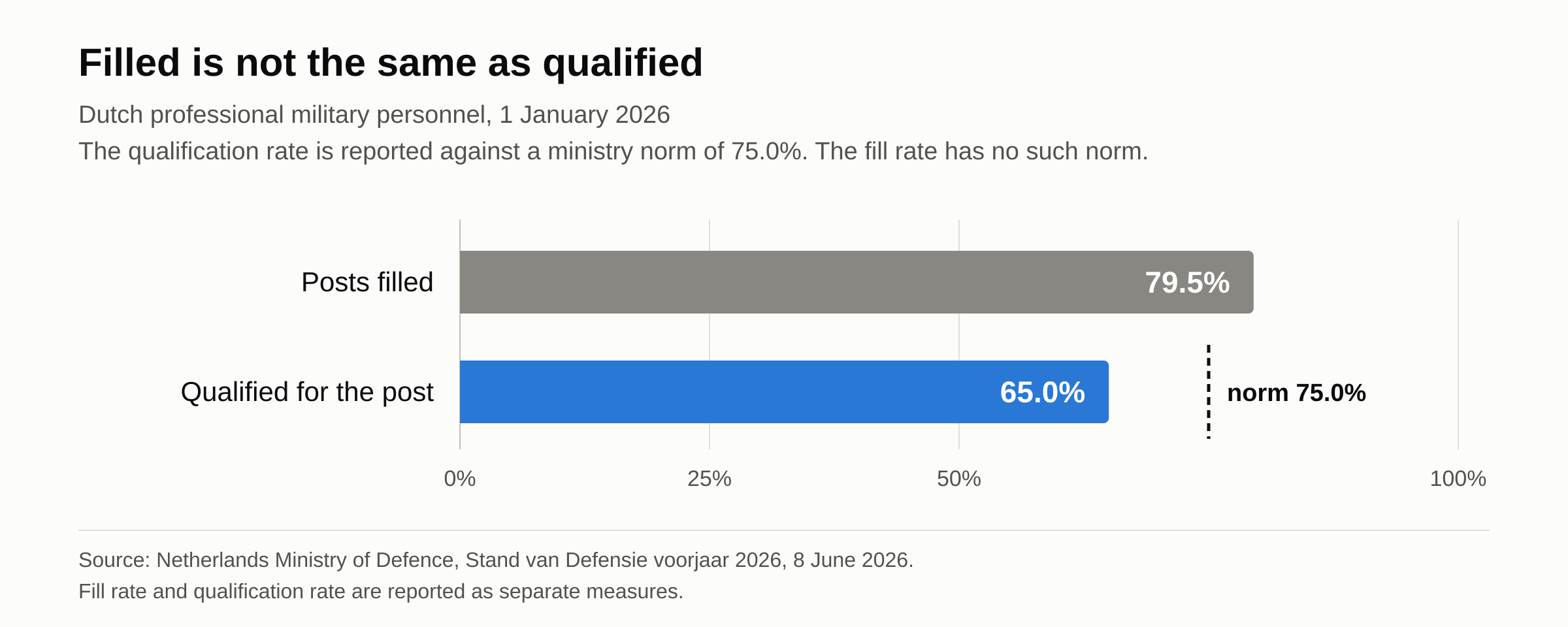
The Netherlands publishes both numbers. Most allies publish neither.
Three figures would tell European publics more about readiness for 2030 than any procurement announcement:
instructor posts filled against establishment;
qualification rate against norm;
annual trained output by trade against the plan.
Most defence ministries already collect all three internally. None is routinely published.
Norway's 54 tanks will arrive by 2028, whatever happens next. Whether there are crews trained to a standard that makes them useful, and whether instructors remain in the schools to train the next crews, is a separate question with a separate schedule. It is being answered now, quietly, in decisions about where to post experienced people. Those decisions deserve the same scrutiny as the contracts.
References
Norwegian Defence Materiel Agency, “Norway's new battle tank has rolled out from the supplier”, fma.no
Norwegian Government, “New Norwegian Long Term Plan on Defence: ‘A historic plan’”, 5 April 2024, regjeringen.no
Norwegian Defence Research Establishment (FFI), Forsvarsanalysen 2025, FFI-rapport 25/006, 18 February 2025
Norwegian Chief of Defence, Fagmilitært råd, chapter 8, 6 June 2023, forsvaret.no
NATO, “Defence investment and NATO's 5% commitment”, nato.int
UK National Audit Office, The UK's F-35 Capability, 11 July 2025
UK National Audit Office, Investigation into military support for Ukraine, 11 September 2024
Bundestag, Jahresbericht 2025 des Wehrbeauftragten, Drucksache 21/4200, 3 March 2026
Der Spiegel, reporting on the internal directive of the Generalinspekteur der Bundeswehr on training capacity, 25 February 2026
DR, “Dobbelt op på værnepligtige bliver en større øvelse”, 16 March 2026, dr.dk
Officerstidningen, “Försvarsmaktens årsredovisning för 2025: tillväxt under belastning”, 2 March 2026
Netherlands Ministry of Defence, Stand van Defensie voorjaar 2026, 8 June 2026
Swedish Government, written answer 2025/26:163, 19 November 2025, riksdagen.se
NATO, Keynote speech by Secretary General Mark Rutte at the NATO Summit Defence Industry Forum, 7 July 2026
Centre for European Reform, Rearming Europe for deterrence, 9 June 2026
BBC News, “British army told to stop non-essential training exercises to save money”, 4 September 2026
Stars and Stripes, “British army halts some training exercises to save money, reports say”, 4 September 2026
Author biography
Ken-Tore Saade Eriksen is the founder of Eriksen LiveSim Consult, an independent advisory practice in defence training and simulation based in Norway. He served in the Norwegian Army for over twenty years, including as commanding officer of the Norwegian Army Combat Training Centre and, from 2018 to 2026, as head of the Norwegian Army Training and Simulation Centre. He retired as a lieutenant colonel in January 2026. His work spans live, virtual, and constructive simulation; training architecture and exercise design; and Nordic and Baltic defence procurement.